

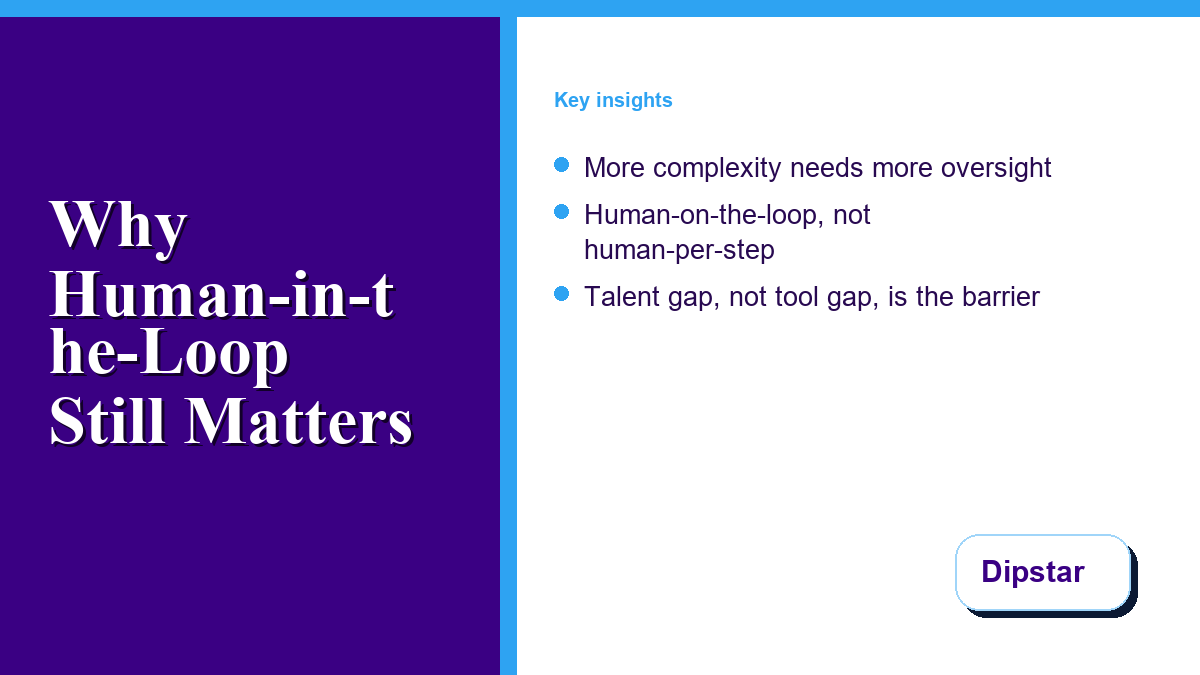
The instinct when adopting AI automation is to measure success by how much human involvement it eliminates. That instinct is backwards for anything with real operational stakes — the organizations getting AI automation right in 2026 are the ones treating human oversight as a permanent design feature, not a training-wheels phase to remove once the system proves itself.
The Paradox Worth Understanding
As automation takes on more complex, higher-stakes work, skilled human oversight becomes more critical, not less — the more complexity a system handles autonomously, the more consequential a single undetected error becomes, and the more valuable a human positioned to catch it before it compounds. Removing the human at that exact point is the opposite of what growing complexity calls for.
What “Human-in-the-Loop” Actually Means in Practice
It doesn’t mean a person reviewing every single automated action — that would defeat the point of automating in the first place. The more accurate model is human-on-the-loop: the system runs autonomously under continuous supervision, and a human retains the ability to intervene when something looks wrong, similar to how a pilot monitors an autopilot system without manually flying the plane the entire flight.
Where This Prevents Real Damage
Administrative and process errors are a documented source of costly mistakes across regulated and semi-regulated operations — healthcare alone attributes the vast majority of its errors to administrative and manual-process failures, precisely the category AI automation is meant to reduce. The catch is that automation without a review layer can introduce a new category of error at higher speed and volume than the manual process it replaced, which is exactly what human-in-the-loop design exists to catch before it reaches a customer or a compliance report.
The Real Barrier Isn’t Technology
A majority of organizations scaling generative AI cite a lack of skilled personnel, not a lack of available tooling, as their main barrier — which means the harder problem is usually building the review capability and judgment on the human side, not finding a more advanced model. A powerful automation system with nobody positioned to competently supervise it is a liability waiting for a bad day, not a finished implementation.
Building This Into an IT Workflow
Effective human-in-the-loop design puts the review checkpoint at the specific step where a wrong action would be expensive or hard to reverse — not at every step, and not at none of them. Platforms built with review checkpoints as a core architectural feature, rather than an afterthought bolted onto a fully autonomous flow, make this easier to implement correctly. Charigent’s human-in-the-loop controls are built around exactly that model — pausing for approval at the specific points where a wrong automated action carries real cost.
The Bottom Line
Full autonomy isn’t the finish line for IT automation maturity — well-placed human checkpoints are. The systems worth trusting with real operational stakes are the ones that make it easy to see what they’re about to do and easy to stop them before they do it.